Always Open, Always Useful: What Japan's Convenience Store Empire Is Teaching Tech About Real Accessibility
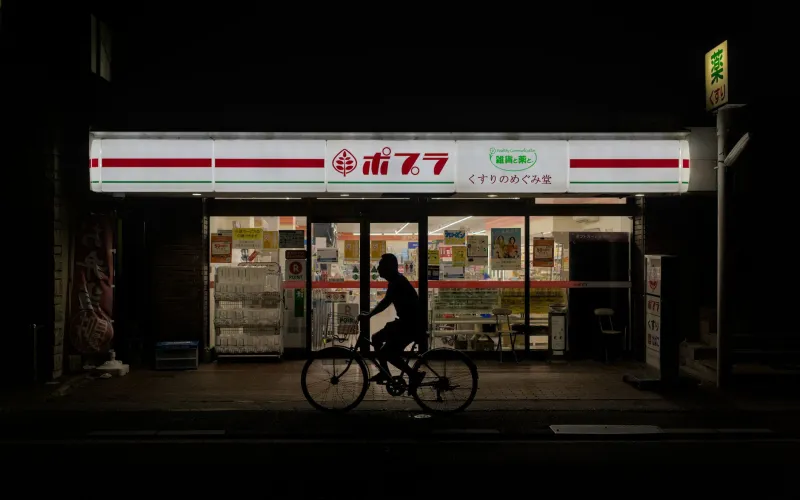
Walk into a 7-Eleven in Tokyo at three in the morning and something quietly remarkable happens. You can pay your utility bills. Print government documents. Pick up concert tickets. Heat up a freshly made bento that, honestly, puts most American sit-down restaurants to shame. Nobody's asking for a subscription. Nobody's nudging you toward a premium tier. The lights are on, the staff is there, and the whole operation hums along like it was designed — genuinely, thoughtfully designed — for the person standing in front of it.
Now open almost any popular American app and count how many seconds it takes before something tries to upsell you, lock a feature behind a paywall, or ask you to create an account before you've even decided if you like the thing. The contrast isn't subtle. It's almost philosophical.
The Konbini as Community Infrastructure
Japan's convenience stores — konbini, in everyday shorthand — number somewhere north of 55,000 locations across the country. That's roughly one for every 2,300 people. In Tokyo, you're rarely more than a few minutes' walk from one. But raw density isn't the interesting part. What's interesting is what these stores have quietly become: a layer of civic infrastructure that most governments would struggle to replicate.
Need to send a package? Konbini handles it. Forgot to pay a parking fine? Konbini terminal. Want a freshly steamed nikuman on a cold January night, or a surprisingly decent craft beer, or a phone charger, or a fax machine? All of it, under the same fluorescent glow, available to anyone who walks through the sliding door.
The Japanese term omotenashi gets thrown around a lot in design and hospitality circles — it roughly translates to a kind of selfless, anticipatory service. But the konbini model is something slightly different. It's less about warmth and more about radical reliability. The promise isn't "we'll delight you." The promise is "we will not fail you, no matter what time it is or what you need."
That's a harder promise to keep. And it's one most American tech companies have quietly stopped making.
Friction Is a Choice
Here's the thing Silicon Valley doesn't like to admit: friction in digital products is almost never accidental. Dark patterns, mandatory sign-ups, artificial loading screens, features buried three taps deep — these are design decisions. They exist because someone, somewhere, decided that a little inconvenience serves a business goal. Maybe it boosts email list numbers. Maybe it makes canceling a subscription feel like defusing a bomb. Whatever the reason, friction is a lever, and American tech pulls it constantly.
Japanese convenience stores operate on the opposite assumption. The entire physical layout, the product selection, the service integrations — all of it is optimized around one central question: what does the person standing here actually need right now? Not what can we get them to buy. Not how do we extend their time in the store. What do they need?
FamilyMart, Lawson, and 7-Eleven Japan have spent decades iterating on that question, and the result is an experience so frictionless it almost disappears. You don't think about using a konbini. You just use it. That invisibility is a design achievement most apps spend millions of dollars trying — and largely failing — to reach.
Democratizing Quality Without Apologizing For It
There's also something quietly radical about the quality ceiling at a Japanese convenience store. The onigiri isn't a compromise. The sandwiches aren't sad. The coffee — made from a machine that grinds beans to order — consistently outperforms what you'd get at a mid-tier American café charging three times the price. Quality isn't rationed based on how much you're willing to spend or what neighborhood you happen to be in.
American tech has a complicated relationship with this idea. On one hand, the whole mythology of Silicon Valley is built on democratization — putting powerful tools in everyone's hands, leveling playing fields, disrupting gatekeepers. On the other hand, the freemium model has become a machine for manufacturing artificial scarcity. The free version is crippled just enough to make you feel the absence of features you'd otherwise never miss. The good stuff lives behind a paywall.
Konbini culture suggests a different model: make the baseline genuinely good, and trust that people will come back because of that goodness, not because you've made leaving feel impossible. It's a loyalty built on merit rather than lock-in. Radical concept, apparently.
What a 24/7 Mindset Actually Means for Tech
When we talk about accessibility in tech, the conversation usually lands on ADA compliance, screen reader support, color contrast ratios. All of that matters enormously. But there's a broader definition of accessibility that the konbini model surfaces — one about time, geography, and economic friction.
Who can use your product at 11 p.m. on a Tuesday when no customer support is available? Who gets locked out because they're on a spotty rural connection? Who's excluded because the onboarding assumes a level of digital literacy that not everyone has?
Japanese convenience stores don't close because it's inconvenient to stay open. They don't stock only premium products because that's where the margin is. They exist to serve the full range of human need, at whatever hour that need shows up. American tech products could stand to ask themselves whether their design philosophy comes anywhere close to that standard — or whether accessibility is something they bolt on as an afterthought, after the real decisions have already been made.
The Lesson Hiding in Plain Sight
There's a reason travelers return from Japan talking about the convenience stores. It's not novelty. It's recognition — the slightly disorienting feeling of encountering a system that actually works for you, rather than one you've learned to work around.
American tech companies have the resources, the talent, and the stated values to build products that feel that way. The konbini model isn't magic. It's a set of priorities: reliability over exclusivity, genuine utility over manufactured engagement, accessibility as a first principle rather than a feature request.
Tokyo figured this out somewhere between the rice balls and the ATMs. The question is whether anyone in San Francisco is paying attention.


