Touch Matters: How Japanese Hardware Designers Are Quietly Humiliating American Peripheral Design
There's a moment that happens to a lot of people the first time they sit down at a keyboard built by Topre Corporation or PFU — the Japanese companies behind the Realforce and the Happy Hacking Keyboard, respectively. They press a key. Maybe they type a sentence. Then they look up with this slightly dazed expression and say some version of the same thing: Why does everything else feel like garbage now?
That moment isn't accidental. It's the result of a design philosophy that has been quietly running laps around the American peripheral industry for decades — one that starts not with specs or price points, but with the human hand.
The Obsession Nobody Talks About
American tech culture loves to talk about user experience, but that conversation almost always lives in the screen. It's about interfaces, flows, onboarding, and color palettes. What happens before the screen — the physical act of reaching out and touching a device — barely registers as a design problem worth solving at the premium tier. Most keyboards shipped with laptops are afterthoughts. Most office mice are designed to a price. The dominant logic is: it works, so what else is there?
Japanese hardware designers answer that question with a career's worth of work.
Take the Topre electrostatic capacitive switch, the mechanism at the heart of every Realforce keyboard. It doesn't operate on the same mechanical principles as a standard Cherry MX switch. Instead, it uses a rubber dome over a spring and a capacitive sensor, which means the actuation point is determined electronically rather than mechanically. The result is a keystroke that feels cushioned at the top, decisive in the middle, and quiet throughout. Engineers at Topre have spent years tuning the spring weights — measured in grams — for different user profiles. Lighter for typists who spend eight hours at a desk. Heavier for users who want more resistance and feedback. The difference between a 30g and a 45g spring isn't something you'd notice in a product listing. You notice it in your wrists after a long day.
That level of granularity is not accidental. It's cultural.
Monozukuri at the Fingertip Level
The Japanese concept of monozukuri — roughly, the art and soul of making things — doesn't really have a clean American equivalent. It's not just craftsmanship. It's a mindset that treats the act of manufacturing as inherently meaningful, where the gap between good enough and genuinely excellent is worth closing even when most customers won't consciously notice the difference.
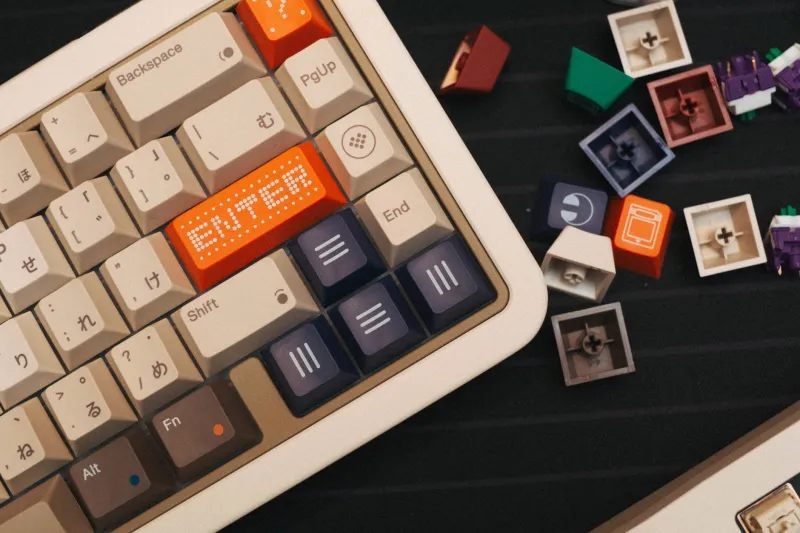
For input device designers, this plays out in places most users never think to look. The weight distribution of a mouse chassis. The angle of a keycap's surface — called the sculpt — and how it guides your fingertip toward the center of the key without you realizing it. The sound profile of a switch at different temperatures. The texture of a wrist rest and how it changes with humidity. These are not marketing differentiators. They are engineering decisions made by people who have thought very hard about what a hand does over the course of a workday.
The HHKB, now on its third generation, is a masterclass in this kind of thinking. It's a 60% layout keyboard — meaning it drops the numpad, the function row, and the navigation cluster — which sounds like a sacrifice until you realize that the design places your most-used keys within a tighter reach envelope, reducing the lateral movement your hands make hundreds of times a day. It was originally designed in the 1980s by a Japanese computer scientist named Eiiti Wada, who wanted a keyboard that matched how programmers actually work rather than how typists were trained to work decades earlier. The philosophy hasn't changed. The execution has just gotten better.
Why American Companies Stopped Caring
This is where it gets a little uncomfortable.
American tech companies didn't always ignore input device quality. Early Apple keyboards had real heft and feedback. IBM's Model M, manufactured in Kentucky in the 1980s, is still widely regarded as one of the greatest keyboards ever made — people pay hundreds of dollars for refurbished units today. The tactile click of an M-series buckling spring switch is so satisfying that an entire hobbyist subculture exists around chasing that feeling.
But somewhere in the race to make devices thinner, cheaper, and more wireless, the physical experience got deprioritized. Chiclet keyboards became standard because they're easier to manufacture and fit under slim aluminum lids. Membrane switches replaced mechanical ones in budget peripherals because the cost difference is significant at scale. The logic made sense from a margin perspective. It made less sense from a human factors perspective — but human factors is expensive to study and hard to put in a press release.
Japanese hardware makers largely didn't make that trade. Partly because their domestic market supported premium pricing for quality goods. Partly because of monozukuri. And partly, frankly, because some of these companies are small enough that they never had to optimize for the lowest common denominator.
The Ripple Effect Into Gaming and Beyond
The gaming peripheral market is where a lot of American users first encounter Japanese hardware precision, even if they don't realize the lineage. Brands like Razer have Japanese manufacturing partners. The tactile switch renaissance that swept the mechanical keyboard community over the last decade drew heavily on Japanese switch engineering. Even the concept of a "linear" versus "tactile" versus "clicky" switch taxonomy — now standard vocabulary in the enthusiast community — owes a lot to the granular thinking that Japanese engineers applied to this problem long before Reddit had a keyboard subreddit.
But this matters way beyond gaming setups. Knowledge workers in America are spending eight, ten, twelve hours a day at input devices. Repetitive strain injuries cost billions in lost productivity and healthcare. The relationship between physical input quality and cognitive load — how much mental energy you spend managing discomfort versus actually working — is real and measurable. When your keyboard requires slightly more force than your tendons prefer, or your mouse forces your wrist into a suboptimal angle, your body compensates. Over months and years, that compensation has consequences.
Japanese hardware designers have been thinking about this for a long time. The American mainstream is just starting to catch up.
What Happens When You Actually Try One
The enthusiast community around high-end keyboards and input devices in the US has exploded over the last five years. Drop.com, formerly Massdrop, built a business around group buys for premium keyboards. Subreddits dedicated to mechanical keyboards have millions of members. Custom keycap sets sell out in minutes. People are spending $200, $300, $500 on keyboards — not because they're status symbols, but because once you've felt what a well-engineered input device actually feels like, the $15 membrane keyboard that came with your office PC becomes genuinely difficult to tolerate.
That's not audiophile elitism. That's ergonomics working the way it's supposed to. The Realforce and the HHKB aren't luxury items because of their price tags. They're luxury items because they were designed by people who took the question of how a human hand interacts with a machine seriously enough to spend years getting the answer right.
America built some of the best input devices in history, then largely walked away from the problem. Japan kept working on it. The gap that opened up in the intervening decades is something you can feel in a single keypress — and once you feel it, you can't unfeel it.